Is a CNC Machining Center Worth It for Automotive? A 4-Point Analysis
Key Takeaways
- Investing in a CNC machining center can significantly improve production consistency and throughput in automotive operations.
- A CNC machine for automotive industry supports tighter tolerances required for critical components.
- Upfront capital costs are high, but long-term efficiency gains can offset the investment.
- ROI depends heavily on production volume, part complexity, and operational discipline.
Introduction
Automotive manufacturing operates under strict requirements for precision, repeatability, and scale. Since product complexity is increasing and tolerances are tightening, many manufacturers evaluate whether upgrading to a Computer Numerical Control (CNC) machining center is justified. While the benefits are clear in theory, the financial and operational implications require careful analysis.
This article breaks down the decision into four practical factors that determine whether investing in a CNC machine for automotive industry makes commercial sense.
1. Production Efficiency and Throughput Gains
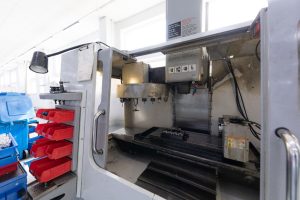
A CNC machining center is designed to handle multi-axis operations, automated tool changes, and continuous production cycles with minimal manual intervention. That said, for automotive businesses, this directly translates into faster cycle times and the ability to run high-volume jobs with fewer interruptions. Compared to conventional machining setups, a CNC machine for automotive industry reduces setup time between parts, especially when dealing with multiple variants of similar components such as brackets, housings, or engine parts.
The efficiency gains become more pronounced in operations with repeatable workflows. Once programmes are optimised, the same machining sequence can be executed repeatedly with consistent output. This is particularly relevant for tier suppliers producing large batches for OEMs. However, these gains are only realised if the production pipeline is stable and demand is predictable. Low utilisation rates will quickly erode the expected efficiency advantage.
2. Precision, Consistency, and Quality Control
Automotive components require tight tolerances, often within microns, especially in engine, transmission, and braking systems. A CNC machining center offers the level of precision required to meet these standards consistently across thousands of units. Unlike manual processes, a CNC machine for automotive industry eliminates operator variability, ensuring that each part conforms to the same specifications.
Consistency is not only about meeting design requirements but also about reducing defect rates and rework. Lower rejection rates directly impact cost efficiency and production timelines. Additionally, CNC systems can integrate with inspection tools and quality control software, allowing real-time monitoring of dimensions and performance. This level of control is not optional for manufacturers supplying safety-critical parts—it is a baseline requirement.
3. Cost Structure and Return on Investment
The most immediate concern for any business is the capital expenditure required to acquire a CNC machining center. Costs include not only the machine itself but also tooling, software, installation, and operator training. This instance can represent a significant financial commitment for smaller automotive businesses.
However, the return on investment should be evaluated over the long term. A CNC machine for automotive industry reduces labour dependency, minimises material waste, and improves production speed. Over time, these factors contribute to a lower cost per unit. The break-even point depends on production volume; high-output environments typically achieve ROI faster. In contrast, businesses with sporadic or low-volume orders may find it more practical to outsource machining instead of investing in in-house capabilities.
4. Scalability and Future-Proofing Operations
Automotive manufacturing is evolving, particularly with the rise of electric vehicles and more complex component designs. A CNC machining center provides the flexibility to adapt to these changes. Multi-axis capabilities allow manufacturers to produce intricate geometries that would be difficult or impossible with older equipment. This quality positions the business to take on more advanced projects and remain competitive in a changing market.
A CNC machine for automotive industry also supports scalability. As demand grows, production can be increased without a proportional rise in labour costs. Additionally, modern CNC systems can be integrated into automated production lines, supporting long-term digitalisation strategies such as Industry 4.0. This quality makes the investment not just a short-term upgrade but a foundation for future expansion.
Conclusion
Investing in a CNC machining center is a strategic decision rather than a simple equipment upgrade. The benefits in efficiency, precision, and scalability can justify the cost, particularly for automotive businesses with consistent demand, complex part requirements, and a focus on quality. However, the investment only delivers value when supported by proper planning, skilled operation, and sufficient production volume. Evaluating these four factors provides a clear framework for determining whether a CNC machine for automotive industry is the right move.
Visit Disk Precision Group and explore the right CNC machining center tailored to your production needs